Glazed Christmas Ham
A cooked ham baked slowly, scored, and lacquered with mustard and brown sugar
- Serves
- 12
- Hands-on
- Total
- Level
- Some skill
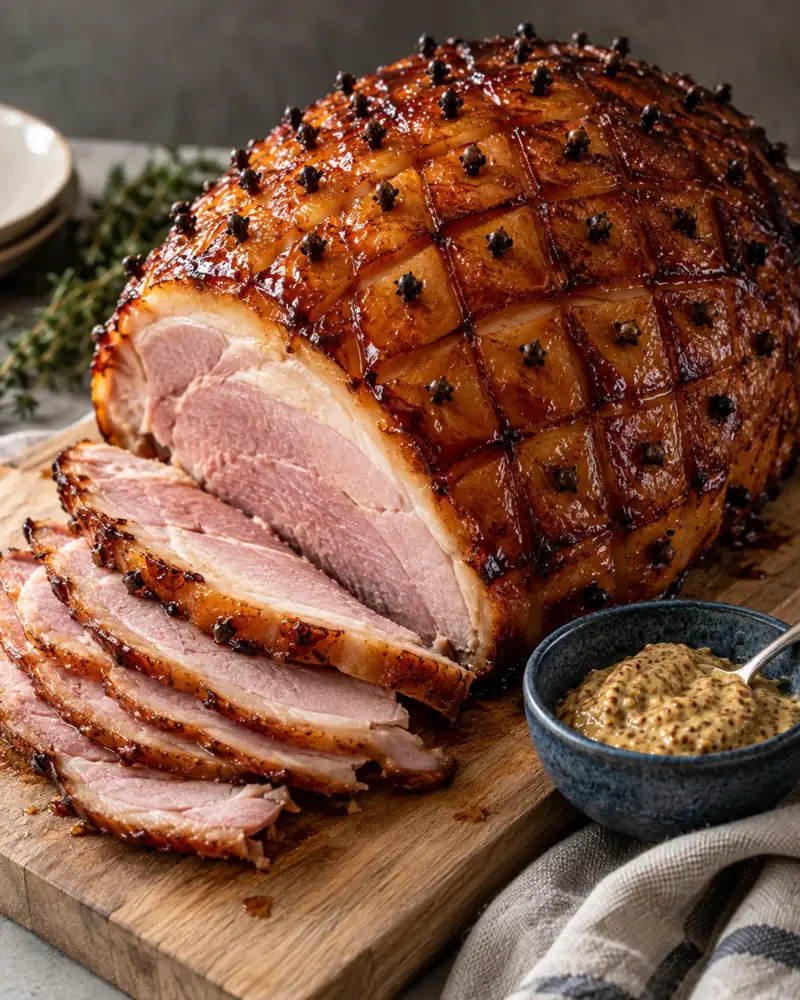
A glazed ham feeds a crowd for days. Start with a cured ham: if it is raw (uncooked gammon), simmer it first; if it's fully cooked, simply warm it through. Either way, the fat is scored into diamonds, studded with cloves and painted with a sticky mustard-sugar glaze that turns dark and glossy in a hot oven.
Ingredients
Ham
- 4 kgbone-in cured ham (9 lb)raw (gammon) or fully cooked, with rind or fat cap; serves 12+
- 2onionshalved, for simmering a raw ham
- 2bay leaves
- 1 tbspblack peppercorns
- 2 lapple cider or water (2 qt)for simmering, plus more water to cover
- 30whole cloves
Glaze
- 100 gdark brown sugar (½ cup)
- 3 tbspDijon or Swedish mustard
- 3 tbsphoney or maple syrup
- 2 tbsporange juice
- ½ tspground ginger
- Diet
- Gluten-free, Dairy-free
- Allergens
- mustard
- Origin
- United Kingdom, United States and Scandinavia
- Season
- Winter
Method
- If your ham is raw and very salty (check the label or ask the butcher), soak it in cold water overnight in the fridge. Drain.
- For a raw ham (a fully cooked ham skips to step 5): put it in a very large pot (at least 10 L) with the onions, bay, peppercorns and cider and top up with water to cover.
- Bring slowly to a simmer and cook very gently, about 20 minutes per 500 g (2½–3 hours for 4 kg), until the internal temperature reaches 63°C (145°F) — 68°C (155°F) for a softer, sliceable texture.
- Cool in the liquid for 30 minutes.
- Heat the oven to 160°C (325°F). Lift the ham onto a board. Peel off the rind with a knife, leaving a 5–10 mm layer of fat. Score the fat in a diamond pattern 2 cm apart, cutting just through the fat. Push a clove into each diamond's center.
- Mix the glaze ingredients. Set the ham on a rack in a foil-lined roasting pan with 1 cm of water.
- For a fully cooked ham only: cover with foil and bake until heated through to 60°C (140°F) in the center — 74°C (165°F) if the ham was repackaged or sliced by a shop rather than sold factory-sealed —, about 12–15 minutes per 500 g (1½–2 hours for 4 kg). (A raw ham simmered in step 2 is already hot.)
- Turn the oven up to 210°C (410°F). Brush the ham with a third of the glaze and bake uncovered for 10 minutes. Brush again and bake 10 minutes; repeat once more, until dark, glossy and bubbling at the edges. Watch that the sugar doesn't burn.
- Rest 20 minutes, then carve into thin slices parallel to the bone. Serve warm or cold with mustard.
Why it works
A ham is already cured — salt has seasoned and preserved it — so the cooking is about heating it through gently without drying it out. Simmering a raw ham in liquid keeps it moist and draws out excess salt. Scoring the fat lets the glaze seep in and the fat render, and applying the sugary glaze in layers at high heat builds a lacquer without scorching.
Common mistakes
- Glazing too early or at low heat — the sugar runs off or burns over a long bake. Glaze only at the end.
- Boiling the ham hard; it turns stringy. Keep it at a bare simmer.
- Not checking the label: raw and cooked hams need different treatment.
Variations
- Norwegian juleskinke
- In Norway, a cold boiled ham is sliced thin for the Christmas table; simmer as in step 2, cool and slice, serving with mustard and pickled cucumber.
- Swedish julskinka
- Skip the sugar glaze; brush with a mix of 1 egg yolk, 2 tbsp mustard and 1 tbsp sugar, sprinkle with breadcrumbs and bake 15 minutes at 225°C (435°F) (add egg and gluten).
Make ahead and storage
Cooked ham keeps 1 week in the fridge, well wrapped; slices freeze for 2 months. Use the bone for Split Pea Soup with Ham.
Notes
Raw gammon is sometimes smoked; it will say on the label. A boneless ham takes about 15% less time. For a fan oven, use 140°C (285°F) and 190°C (375°F).