Country Sourdough
From a jar of flour and water to a blistered, tangy loaf, step by step
- Makes
- 1 round loaf (about 900 g), plus a starter to keep
- Hands-on
- Total
- Level
- Project
Sourdough uses a living culture of wild yeast and bacteria instead of packaged yeast, and the slow fermentation gives a crust and flavor nothing else can. This recipe starts at the very beginning with a seven-day starter, then walks you through one reliable loaf with a cold overnight rise that fits around a working day.
Ingredients
Starter (7 days; ongoing feeding)
- 500 gwhole-wheat or wholegrain rye flour (about 4 cups)for the first 2 days and as part of later feeds; then any mix of whole-wheat and bread flour
- 500 glukewarm water (about 25°C, 77°F) (about 2 cups)unchlorinated if possible; leave tap water out overnight
Dough
- 100 gactive starter, at its peak (scant ½ cup)
- 375 glukewarm water (about 27°C, 80°F) (1½ cups + 1 tbsp)
- 450 gbread flour (3½ cups + 2 tbsp)
- 50 gwhole-wheat flour (⅓ cup + 1 tbsp)
- 10 gfine sea salt (1¾ tsp)
- rice flourfor dusting the proofing basket; it doesn't absorb water and stops sticking
- Diet
- Vegetarian, Vegan, Dairy-free
- Allergens
- gluten
Method
- Starter, days 1–2: In a clean 1 L jar, stir 50 g whole-wheat or rye flour with 50 g lukewarm water to a thick paste. Cover loosely and leave at warm room temperature (22–26°C, 72–79°F). On day 2, stir in another 50 g flour and 50 g water, whether or not you see bubbles.
- Starter, days 3–5: Once a day, discard all but 50 g of the starter, then stir in 50 g flour (from now on half whole-wheat, half bread flour is fine) and 50 g water.
- It may bubble wildly on day 2 or 3, then go quiet and smell sour or like nail polish; that is normal as the right microbes take over. Keep feeding.
- Starter, days 6–7: Feed every 12 hours in the same way. It is ready when it reliably doubles within 4–6 hours of a feed, has a domed, bubbly top and smells pleasantly yeasty and tangy. If it isn't there by day 7, keep feeding twice daily for a few more days; cool kitchens take longer.
- Dough, morning: Feed the starter 4–6 hours before you mix so it is at its peak. In a large bowl, stir 100 g of the active starter into the 375 g water until milky. Add both flours and mix by hand until no dry flour remains. Cover and rest 45 minutes.
- Sprinkle the salt over the dough with a splash of water and squeeze it through with a wet hand for 2 minutes, until fully absorbed. The dough will tear, then come back together.
- Bulk rise: over the next 2 hours, do 4 sets of stretch and folds, 30 minutes apart. With a wet hand, grab one side of the dough, stretch it up until it resists, fold it over the middle, turn the bowl a quarter and repeat 4 times.
- Then leave the dough covered until it has risen by about 50%, is domed, jiggly and shows bubbles at the sides, 4–6 hours from mixing in total at 24°C (75°F).
- Tip the dough onto an unfloured counter. Using a bench scraper or your hands, push it into a loose round and rest 20 minutes uncovered.
- Lightly flour the top, flip it over, then fold the bottom third up, the sides in and the top down. Roll it toward you into a tight ball. Place it seam-side up in a proofing basket or a bowl lined with a linen towel, both well dusted with rice flour.
- Cover and refrigerate for 8–16 hours. The cold slows fermentation, deepens the flavor and makes the dough firm enough to score cleanly.
- Next morning, put a 4–6 L lidded heavy pot in the oven and heat to 250°C (480°F) for 45 minutes. Turn the cold dough onto baking paper, seam-side down, and slash the top once, about 1 cm deep, with a razor blade or very sharp knife held at a shallow angle.
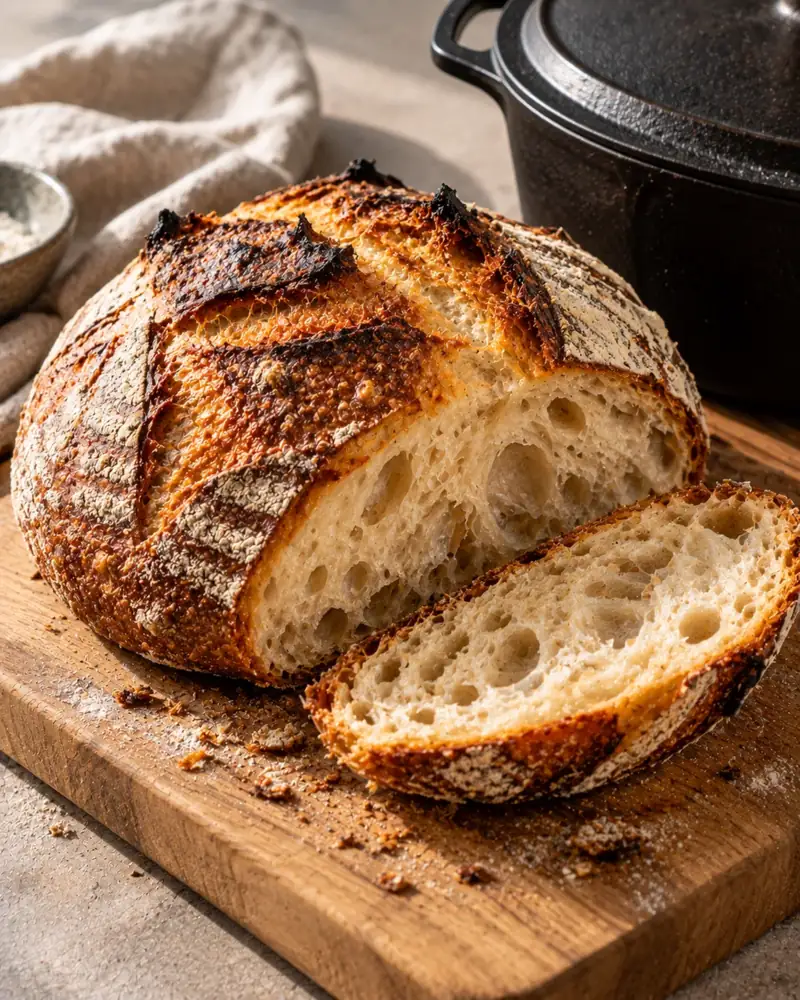
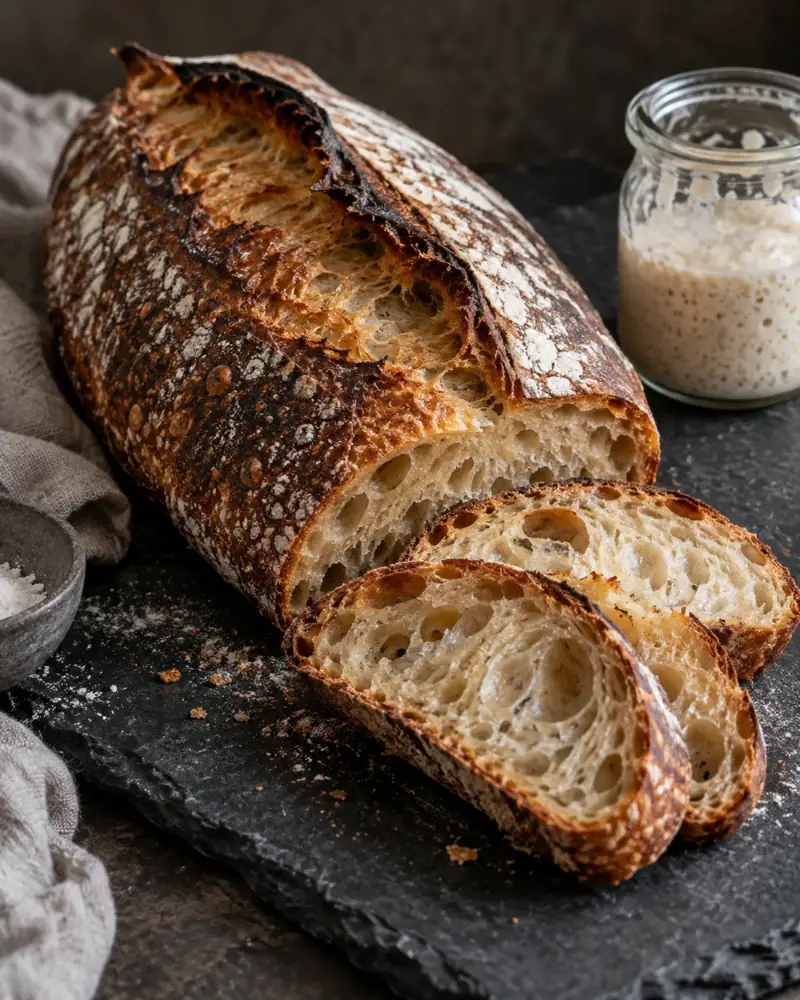
- Lower the loaf into the pot on its paper, cover and bake 20 minutes. Remove the lid, reduce to 230°C (450°F) and bake 20–25 minutes more, until the crust is deep mahogany and the inside reads 96°C (205°F).
- Cool on a rack for at least 1½ hours before cutting. Keep the remaining starter in the fridge and feed it once a week (discard to 50 g, add 50 g flour and 50 g water), then give it one or two feeds at room temperature before baking.
Why it works
A starter is a stable community of wild yeasts, which make the gas, and lactic and acetic bacteria, which make the tang; feeding it daily selects for the strongest, fastest ones. Fermentation is slower than with packaged yeast, so enzymes have hours to release sugars and aromas, and the acids strengthen gluten and help the bread keep. The cold overnight rise lets you bake on your own schedule and gives the blistered crust.
Common mistakes
- Using a starter that isn't at its peak. If it hasn't doubled since the last feed, your dough will be slow and dense; a spoonful should float in water.
- Judging the bulk rise by time. Temperature changes everything; look for a 50% rise, a domed surface and bubbles.
- Giving up on day 3. The quiet, sour phase is a normal part of a new starter, not a failure.
Variations
- Seeded sourdough
- Toast 100 g mixed seeds, soak them in 60 g boiling water while the dough rests, and squeeze them in with the salt.
- Higher whole-grain
- Use 350 g bread flour and 150 g whole-wheat or spelt flour, and add 15 g extra water.
Make ahead and storage
The shaped loaf can stay in the fridge up to 24 hours before baking; the flavor gets more sour. Baked bread keeps 3–4 days cut-side down on a board and freezes well for 3 months.
Notes
Hydration 75% (375 g water to 500 g flour); about 77% if you count the flour and water in the starter. Fan oven: 230°C (445°F) lid on, 210°C (410°F) lid off. Discarded starter can go into pancakes or crackers. A dough temperature of 24–26°C (75–79°F) gives the timings above; in a colder kitchen, use warmer water and expect a longer bulk rise. Total time counts one baking cycle from feeding an established starter (about 25 hours) and does not include the 7 days needed to create the starter.