Peruvian Ceviche
Raw white fish "cooked" in lime with chili, red onion and cilantro
- Serves
- 4
- Hands-on
- Total
- Level
- Some skill
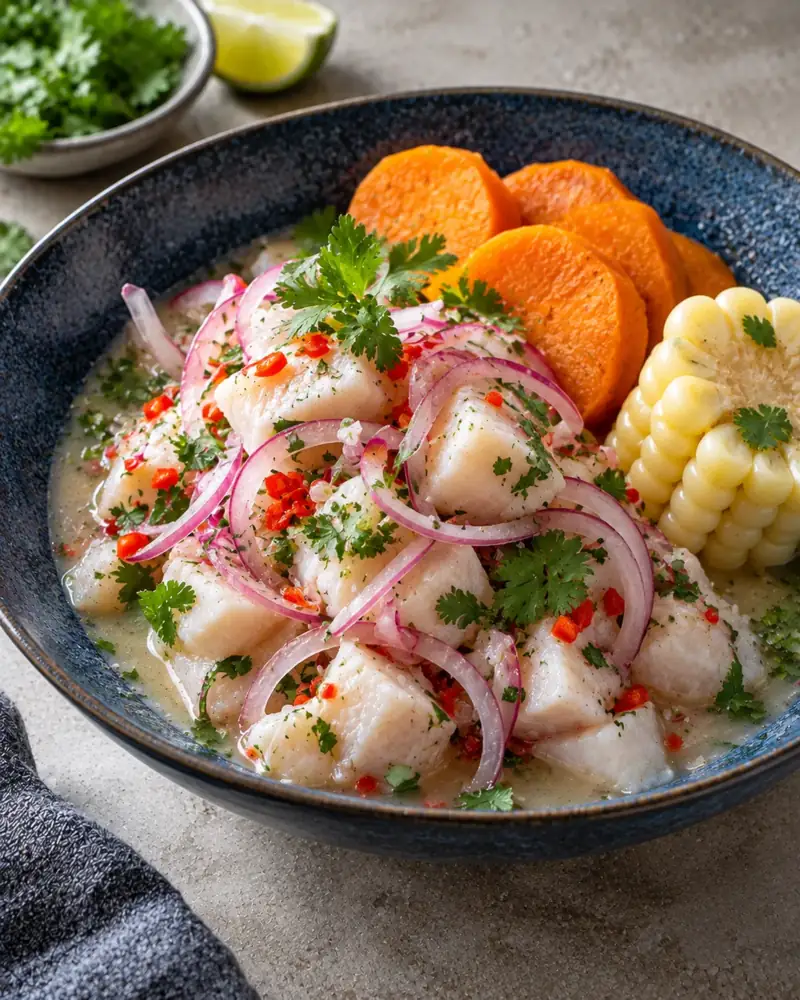
Peru's national dish is a study in freshness: bright white fish cut into cubes and tossed with lime juice, chili, onion and salt minutes before serving. The juices that collect — leche de tigre, "tiger's milk" — are as prized as the fish. In Lima it comes with sweet potato and corn to balance the acid.
Ingredients
Ceviche
- 500 gvery fresh skinless white fish for raw use (1 lb 2 oz)sea bass, halibut, sole or corvina, previously frozen (see safety note)
- 1small red onionsliced paper-thin, rinsed
- 6 gfine sea salt (1 tsp)
- 1fresh hot chiliají limo, or a red chili or ½ habanero, seeded and very finely chopped
- 150 mllime juice (⅔ cup)from 6–8 limes, freshly squeezed
- 1 clovegarlicgrated
- 1 cmfresh gingergrated
- 3 tbspchopped cilantro
- 3ice cubes
To serve
- 1orange sweet potatoabout 300 g, boiled or roasted, in thick slices
- 1corn cobboiled, cut into rounds; or toasted corn nuts
- 4lettuce leaves
- Diet
- Gluten-free, Dairy-free, Pescatarian
- Allergens
- fish
- Origin
- Peru
- Season
- Summer
Method
- Make sure the fish has been frozen (see note). Keep it in the coldest part of the fridge, at or below 4°C (39°F), until the moment you cut it. Chill a glass or ceramic bowl.
- Soak the sliced onion in iced water for 10 minutes to soften its bite, then drain well.
- Cut the fish into neat 2 cm cubes with a sharp knife, removing any dark or bloody bits. Put it in the chilled bowl.
- Season the fish with the salt and toss. Wait 1 minute: the salt starts to firm the surface and draws out a little juice.
- Add the chili, garlic, ginger, ice cubes and lime juice. Stir gently for a minute or so with a spoon.
- Leave for 2–10 minutes in the fridge, depending on taste. At 2 minutes the cubes are white outside and raw-silky inside, as in Lima; by 10 minutes they are opaque most of the way through.
- Remove the ice cubes. Fold in the onion and cilantro. Taste the juice: it should be sharp, salty and hot at once. Adjust with salt or lime.
- Spoon into bowls with plenty of leche de tigre, with sweet potato, corn and a lettuce leaf alongside. Serve within 15 minutes.
Why it works
Lime acid denatures the fish's surface proteins, much as heat does, turning them opaque and firm — but it does not reliably kill bacteria or parasites the way cooking does, which is why fish quality and freezing matter. Salting first opens up the flesh so it absorbs flavor fast. Ice keeps everything cold while chilling the juice that becomes leche de tigre.
Common mistakes
- Marinating for hours, as older recipes say: the fish turns chalky and dry. Minutes are enough.
- Bottled lime juice tastes flat and bitter. Squeeze fresh, and don't press the limes too hard, which releases bitter oils.
- Using warm fish or a warm bowl. Everything should be fridge-cold.
Variations
- Leche de tigre shot
- Blend the leftover juices with a few fish scraps and a celery stick, strain and serve in small glasses. Add celery to the allergens.
- Shrimp ceviche
- Poach peeled shrimp in boiling salted water until just pink and opaque, 1–2 minutes, chill in iced water, then proceed with a 5-minute marinade. Add crustaceans to the allergens.
Make ahead and storage
Prep the onion, chili and sides up to 4 hours ahead. Combine the fish and lime only just before serving; ceviche doesn't keep.
Notes
SAFETY: this fish is not cooked by heat, so quality and freezing replace an internal temperature. Buy fish sold for raw use ("sushi grade" has no legal meaning — ask for fish suitable for eating raw) from a fishmonger you trust: it should smell only of the sea, look glossy and spring back when pressed. Unless it has been commercially frozen, freeze it at −20°C (−4°F) or colder for at least 24 hours (7 days in a home freezer that can't reach −20°C is the cautious rule), then thaw in the fridge. Keep it cold right until serving. Raw fish is best avoided during pregnancy and by young children, older adults and anyone with a weakened immune system. Ají limo or ají amarillo paste is available online and in Latin American shops; red chili is an honest substitute.